

 by
by 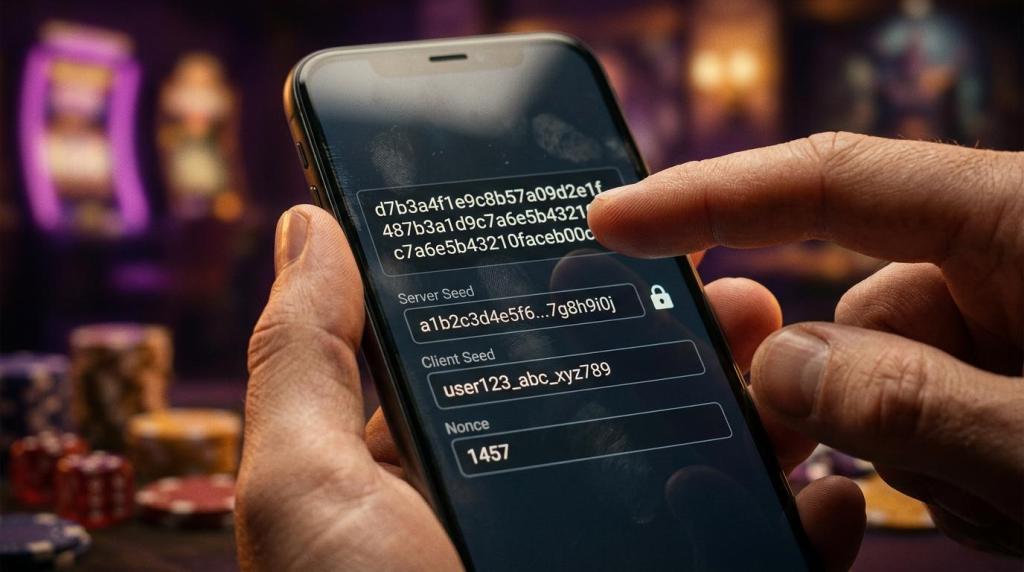
When players ask what a provably fair casino is, they are really asking a more valuable question: Can I check the result myself, or do I just have to trust the operator?
That is what makes the idea so appealing. A traditional online casino usually asks you to trust its licence, its game providers, and its testing labs. A provably fair casino adds something stronger for certain games: a way to verify that the result was not changed after your bet was placed.
Provably fair systems are often linked with crypto casinos, yet the concept is broader than payment choice. It is a technical method for proving that a game outcome came from a pre-committed process, not from an operator deciding what should happen after seeing your wager.
What a provably fair casino actually is
A provably fair casino uses cryptographic proof to let players verify game outcomes. In most cases, this applies to in-house games like dice, crash, limbo, mines, or simple card formats rather than to the entire catalogue.
The usual model works with three pieces of data: a server seed, a client seed, and a nonce. The casino creates the server seed and shows you a hashed version of it before the bet. That hashed value is the commitment. Because a hash is one-way, the casino can commit to a seed without revealing it up front. You, or the system on your behalf, provide the client seed. The nonce is a counter that changes with each bet.
After the bet, the result can be reproduced by combining those inputs through a published formula, often based on SHA-256 or HMAC-SHA256. If the revealed server seed matches the earlier hash and the calculation matches the result shown on screen, the operator did not alter that outcome after the fact.
Provably fair is about transparency, not better odds.
A fair game can still have a house edge. A provably fair dice game with a 1% edge is still a 1% edge game. What changes is your ability to confirm that the random process and the published rules were followed.
How provably fair game results are generated
The strength of provably fair gaming comes from commitment before the outcome and verification after it. If either part is missing, the claim becomes much weaker.
Here is the basic structure most players will see:
| Element | What it is | Why it matters |
|---|---|---|
| Server seed | A secret value created by the casino | Determines the hidden side of the result generation |
| Hashed server seed | The fingerprint of the server seed shown before play | Proves the casino committed to a value before the bet |
| Client seed | A value provided by the player or assigned in the interface | Gives the player a direct input into the result |
| Nonce | A number that increments with each bet | Prevents repeated use of the exact same inputs |
| Hash algorithm | Usually SHA-256 or HMAC-SHA256 | Produces a deterministic result from the inputs |
| Conversion formula | The method used to turn the hash into a dice roll, card order, or crash multiplier | Lets anyone reproduce the exact game outcome |
If a casino publishes all of this clearly, a player can test whether the outcome matches the data. That is the core promise. No mystery. No “just trust us”.
How to verify a provably fair game result yourself
The good news is that the process is easier than it sounds once you have done it once or twice. You do not need to be a developer. You just need the raw inputs and an independent way to hash or calculate them.
A proper provably fair page should show the commitment hash before you play, then reveal the server seed later, often when you rotate seeds or check a game history entry. It should also explain the formula used to map the final hash to the game result.
A simple provably fair verification process
After you have played a round, a manual check usually looks like this:
- Save the commitment hash: Copy the hashed server seed shown before the bet.
- Record the game details: Note the client seed, nonce, and displayed outcome.
- Reveal the server seed: Use the game history or seed rotation tool to access it.
- Hash the server seed independently: Confirm it matches the original commitment hash.
- Recalculate the result: Use the published formula to see whether the output matches the actual game result.
The word independently matters. A casino’s own verifier can be helpful, but it should not be your only check. Even a basic SHA-256 tool, command line utility, or open-source script gives you a cleaner test because the calculation happens outside the casino’s interface.
If a site calls a game provably fair but does not let you view the seeds, see the nonce, or reproduce the formula, that is not the standard players should expect.
What to look for in a real provably fair casino
A strong provably fair setup is visible, documented, and easy to test. You should not have to search through five help pages and two menus to find the proof tools.
Good platforms make the process feel normal rather than hidden. You can see the pre-bet commitment, adjust your client seed if you want, review old bets, and verify outcomes without contacting support.
The most reliable signs are practical ones:
- visible server seed hash before each betting session
- client seed control
- nonce display in bet history
- public formula for converting hashes into outcomes
- bet-by-bet verification records
- clear note on which games are covered
Another important point is scope. Many casinos use “provably fair” to describe a small set of in-house games while most of their slots, live tables, and branded content still run on traditional audited RNG systems. There is nothing wrong with that, but it should be stated plainly.
Players should also look for supporting trust signals beyond the cryptographic layer. A sound licence, reputable software partners, fair terms, and responsible gaming tools still matter. Provable verification is powerful, yet it is not the only measure of a trustworthy casino.
Provably fair games versus audited RNG casino games
A lot of confusion starts here. Provably fair and audited RNG are not the same thing, even though both aim to support fair play.
Traditional online casino games, especially third-party slots and live dealer titles, usually depend on certified random number generators that are tested by external labs. Players do not verify each spin themselves. They trust the provider, the auditor, and the regulator.
Provably fair games shift part of that trust back to the player by making the outcome reproducible. That is a different standard, and it is usually easier to apply to simple digital games than to a huge multi-provider catalogue.
| Feature | Provably fair model | Audited RNG model |
|---|---|---|
| Result checking | Player can verify the outcome directly | Player relies on lab testing and provider integrity |
| Transparency | Seeds, hashes, nonce, formula | RTP disclosures, certification, licensing |
| Best fit | In-house games like dice, mines, crash | Slots, table games, live dealer content |
| Trust model | Cryptographic proof plus platform trust | Third-party audits plus platform trust |
| Player control | Often includes client seed settings | Usually no player input into randomness |
This difference matters when assessing any casino with a large game library. If a platform offers thousands of games from dozens of providers, it is unlikely that every title is provably fair in the technical sense. Many of those games will be audited and regulated rather than seed-verifiable.
That does not make them bad games. It just means players should use the right label and set the right expectations.
Red flags in provably fair casino claims
Marketing language can blur the line between real verification and general fairness claims. A casino may use the phrase because it sounds modern, transparent, and crypto-native. The actual details tell the real story.
Watch for signs that the proof layer is weak, partial, or impossible to test:
- No pre-bet hash shown: You cannot verify a prior commitment if nothing is displayed before the wager.
- No client seed access: Without player input or visibility, the system is less transparent than it appears.
- No raw data in game history: A result without seeds and nonce cannot be recreated properly.
- Verification only inside the casino tool: Helpful, but not enough on its own.
- Vague coverage language: “Provably fair casino” may refer to only a handful of games.
- No documentation: If the formula is missing, independent checking becomes guesswork.
There is another common issue. Some sites combine “licensed”, “audited”, and “provably fair” as if the terms were interchangeable. They are not. Licensing speaks to legal oversight. Audits speak to statistical and operational checks. Provably fair speaks to player-side verification of specific outcomes.
A careful player separates those layers instead of treating them as one broad trust badge.
How to assess casino fairness before you play
Before depositing, start with a simple test: can you find the fairness information in under a minute? If the answer is no, the site may not be putting transparency first.
Check whether the casino explains which games are provably fair and which are simply certified by providers. On many large platforms, especially those built around major studio content, fairness may come mainly from provider audits, published RTP figures, and licensing rather than from seed-based verification. That is a valid model, but it is not the same thing.
A useful checklist looks like this:
- Game coverage: Which titles are actually provably fair?
- Proof mechanics: Are server seed hashes, client seeds, and nonces visible?
- Independent verification: Can you reproduce results away from the casino interface?
- Audit support: Are there testing labs, provider certifications, or payout reports?
- Licence quality: Is the regulatory information clear and easy to verify?
If a casino offers both models, that can be a strong setup. You get seed-verifiable in-house games for direct checking, plus audited third-party content for variety. What matters most is honesty about which standard applies to which game.
Players who know that distinction are in a much better position. They can verify where verification is possible, rely on audits where that is the actual framework, and avoid confusing technical proof with marketing language.